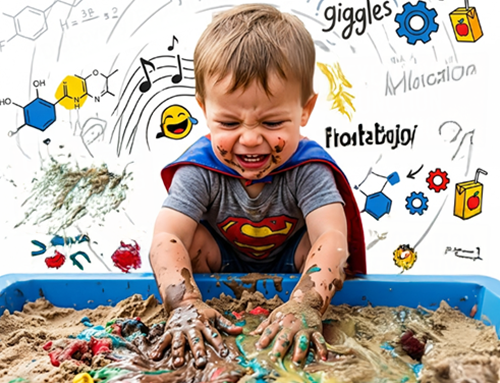
Let’s get real. We’ve all been there: you pick up your kid at the end of the day and they have blue hair, marked-up hands, and a crusting on their shirt that you’re not sure you’ll ever be able to get out. But they have the biggest smile. They are so happy for the day they just had. That is amazing, incredible, beautiful, wonderful brain development. That’s the proof.
That first thought of the added laundry task quickly fades into absolute understanding because you get it. You get it like we get it. After 40 years in this business that my mom started, I’ve seen a thousand loads of laundry walk out of our doors. I know some of them probably didn’t make it to the “next life.” But I also know that’s okay, judging by the parents laughing with their kids at the beautiful day they just shared.
I absolutely love the mess. While we do try to keep the kids as clean as possible, if there’s glitter and glue involved, sometimes it just happens! Here at Valley Learning Center, we celebrate this mess. It’s backed by science. No, we’re not “science geeks,” but if you understand the reason behind the mess and what lies underneath the goo and goop, you will love it just as much as we do.
Building a Brain, One Squish at a Time
The kids aren’t just making a mess; they’re building their brains. A toddler elbow-deep in a sensory bin is a child filled with potential. It looks like chaos, but if you could see what’s going on in their head, you’d see a sky full of fireworks.
Between birth and age 5 is when the brain grows the fastest. It’s engineered to be in high gear. Every time they touch something—whether it’s slime, something rough, squishy, or smooth—their brain fires off new neurons and pathways. You might see a mess, but the “playful construction crew” in their head is building the scaffolding for their entire future. They are loading away a sensory library of information to draw from as they grow.
Why Playdough Comes Before Pencils
Parents often ask when their 3-year-olds will start writing letters. Our answer? When they stop playing with playdough. Writing requires serious hand strength, coordination, and dexterity. The act of squishing clay, scooping rice, and pouring water fires off the muscles that connect directly to that “sync” happening in their brain. Before they can hold a pencil, they need to play with thousands of grains of sand and fists full of mud.
Little Scientists in the Lab
Think of it this way: kids are like little scientists. Jean Piaget, one of the grandfathers of child psychology, famously taught that children learn by interacting directly with their world—not just looking at it.
Messy play is their laboratory. They are testing hypotheses all day:
What happens if I mix red and yellow? * Will this heavy rock sink or float? * How much water fits before the bucket overflows? They are recording textbook physics, chemistry, and volume before those things even have names.
Our Promise to You
Veteran teachers actually get worried when a child stays perfectly clean all day; it often means they were too hesitant to really dive into the learning. We know a messy face is the sign of a successful day.
But we also know you don’t want to scrape clay off your car seats! We are mindful of keeping our kids neat, and we promise to handle the “messy science” so you don’t have to do it all at home. We have the industrial sinks, the smocks, and the patience for glitter explosions.
One tip: If you send them in their “Sunday Best,” it’s probably not a good idea. But please don’t send them in plastic jumpsuits either! Help us help them build those amazing brains. These are our next generation of scientists and teachers, and we’re smiling with them through every single experiment.
#ParentingHacks #ValleyLearningCenter #Makingamess #Creative #BrainDevelopment